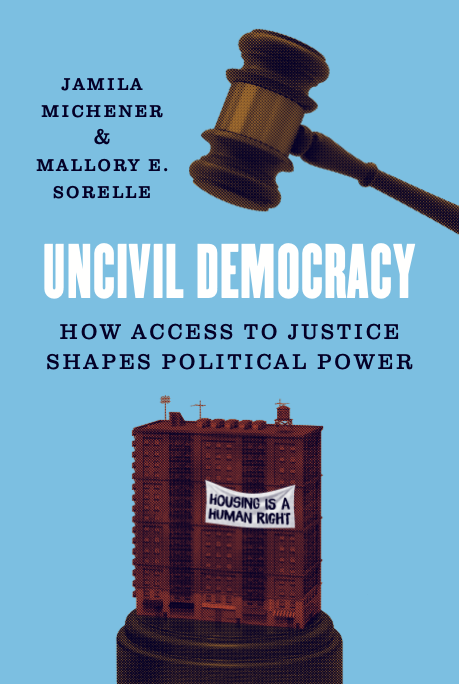
Uncivil Democracy: how access to justice shapes political power (2026)
From the Publisher: Each year, as many as 250 million Americans face civil legal problems like eviction, debt collection, and substandard housing. These problems are disproportionately shouldered by racially and economically marginalized people, particularly women of color. Civil courts and legal aid organizations are supposed to protect their rights, yet more than 90 percent of low-income people receive inadequate or no legal assistance. Instead, access to justice is reserved for those who can afford its high price. For those who can’t, the repercussions can be devastating, from homelessness and loss of public benefits to broken families and diminished health. Uncivil Democracy looks at the US civil justice system through the eyes of the people whose very citizenship is indelibly shaped by it.
Jamila Michener and Mallory SoRelle show how civil legal problems, and the institutions meant to address them, greatly erode trust in the legal system among marginalized communities, undermining their broader sense of democratic citizenship and political standing. While legal representation offers vital protections, increased access to justice through an ever-growing supply of lawyers does not address the structural problems that generate demand for lawyers in the first place. Looking at cases involving unfair evictions and substandard housing, Michener and SoRelle demonstrate how community groups such as tenants’ unions can fill this justice gap and provide the means to build political power that transforms the conditions that create precarity.
Drawing on eye-opening qualitative evidence and a wealth of historical and survey data, Uncivil Democracy explains why collective organizing holds the greatest promise for altering the systems that create civil legal problems and exercising the political power necessary for meaningful change.
Democracy Declined: the failed politics of consumer financial protection (2020)
Featured in The Washington Post Monkey Cage; Reviewed in Perspectives on Politics, American Banker
From the Publisher: As Elizabeth Warren memorably wrote, “It is impossible to buy a toaster that has a one-in-five chance of bursting into flames and burning down your house. But it is possible to refinance an existing home with a mortgage that has the same one-in-five chance of putting the family out on the street.” More than a century after the government embraced credit to fuel the American economy, consumer financial protections in the increasingly complex financial system still place the onus on individuals to sift through fine print for assurance that they are not vulnerable to predatory lending and other pitfalls of consumer financing and growing debt.
In Democracy Declined, Mallory E. SoRelle argues that the failure of federal policy makers to curb risky practices can be explained by the evolution of consumer finance policies aimed at encouraging easy credit in part by foregoing more stringent regulation. Furthermore, SoRelle explains how angry borrowers’ experiences with these policies teach them to focus their attention primarily on banks and lenders instead of demanding that lawmakers address predatory behavior. As a result, advocacy groups have been mostly unsuccessful in mobilizing borrowers in support of stronger consumer financial protections. The absence of safeguards on consumer financing is particularly dangerous because the consequences extend well beyond harm to individuals—they threaten the stability of entire economies. SoRelle identifies pathways to mitigate these potentially disastrous consequences through greater public participation.
Hello, World!
Listen Here to Learn More:

Other Publications
Peer Reviewed Journal Articles
Andrew Trexler, Marayna Martinez, and Mallory SoRelle. 2025. “Voting Access Reforms and Policy Feedback Effects on Political Trust and Efficacy,” Policy Studies Journal, 53(2): 524-540.
Mallory E. SoRelle and Allegra Fullerton. 2024. “Policy Feedback Effects of Preemption,” Policy Studies Journal, 52(2): 235-255.
Mallory E. SoRelle and Serena Laws. 2024. “Deservingness and the Politics of Student Debt Relief,” Perspectives on Politics, 22(2): 372-390.
Mallory E. SoRelle and Delphia Shanks. 2024. “The Policy Acknowledgement Gap: Explaining (Mis)Perceptions of Government Social Program Use,” Policy Studies Journal, 52(1): 47-71.
Winner of the 2016 APSA Best Poster in Public Policy Award
Mallory E. SoRelle and Serena Laws. 2023. “The Political Benefits of Student Debt Relief,” Research & Politics, 10(2).
Mallory E. SoRelle. 2023. “Privatizing Financial Protection: Regulatory Feedback in the Credit Welfare State,” American Political Science Review, 117(3): 985-1003.
Winner of the 2020 APSA Best Paper in Public Policy Award
Jamila Michener, Mallory E. SoRelle, and Chloe Thurston. 2022. “From the Margins to the Center: A Bottom-up Approach to Welfare State Scholarship,” Perspectives on Politics, 20(1): 154-169.
Winner of the 2023 APSA Heinz I. Eulau Best Article in Perspectives on Politics Award
Jamila Michener and Mallory E. SoRelle. 2022. “Politics, Power, and Precarity: How Tenant Organizations Transform Local Political Life.” Interest Groups & Advocacy, 11(2): 209-236.
Mallory E. SoRelle. 2022. “From Personal Responsibility to Political Mobilization: Using Attribution Frames to Overcome Policy Feedback Effects.” American Politics Research, 50(2): 173-185.
Delphia Shanks and Mallory E. SoRelle. 2021. “The Paradox of Policy Advocacy: Philanthropy, Public Interest Groups, & Second-order Policy Feedback Effects.” Interest Groups & Advocacy, 10(2): 137-157.
Winner of the 2022 (inaugural) Jordan-Loomis Best Article in IG&A Award
Mallory E. SoRelle and Alexis N. Walker. 2016. “Partisan Preemption: The Strategic Use of Federal Preemption Legislation.” Publius: The Journal of Federalism, 46(4): 486-509.
Book Chapters
Mallory E. SoRelle. 2026. “Policy Feedback,” In eds. Larry Jacobs and Desmond King, Picking Winners: Citizenship, Central Banks, and Consumer Finance, Oxford.
Suzanne Mettler and Mallory E. SoRelle. 2023 [2017, 2014]. “Policy Feedback.” In eds. Chris Weible and Paul Sabatier, Theories of the Policy Process, 5th ed. Routledge.
Mallory E. SoRelle and Jamila Michener. 2022. “Policy Feedback,” In eds. Chris Weible and Samuel Workman, Methods of the Policy Process, Routledge.
Mallory E. SoRelle and Suzanne Mettler. 2021. “More Than Meets the Eye: Government’s Role in American Social Provision and Its Implications for ‘Public Option’ Alternatives,” In eds. Ganesh Sitaraman and Anne Alstott, Politics, Policy, and Public Options, Cambridge University Press.